
Fragment#01
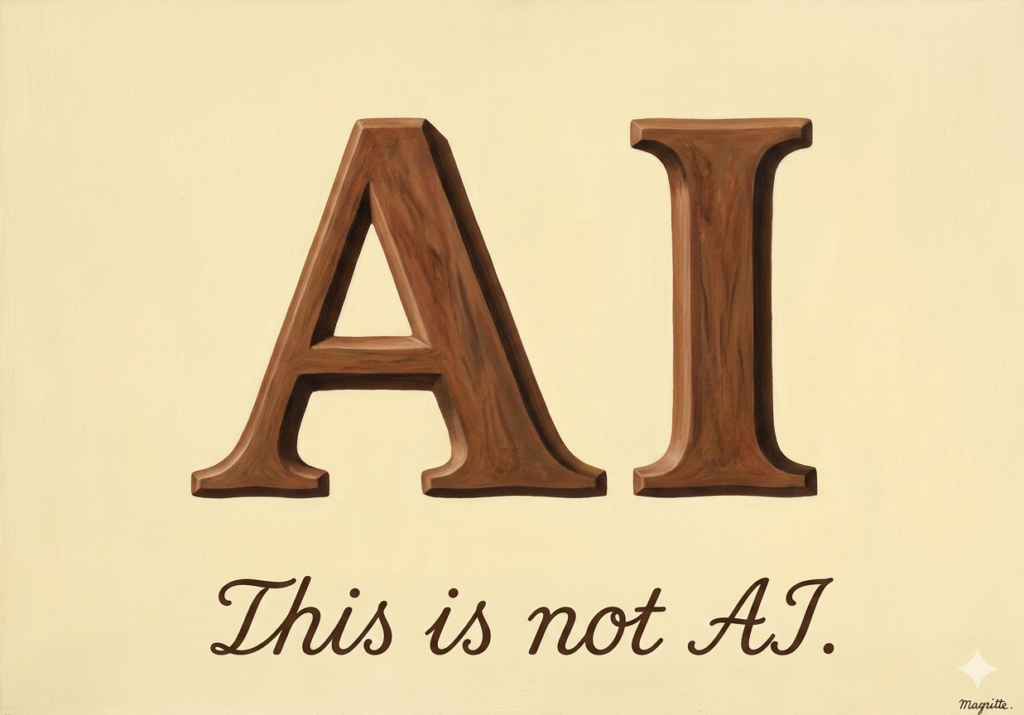
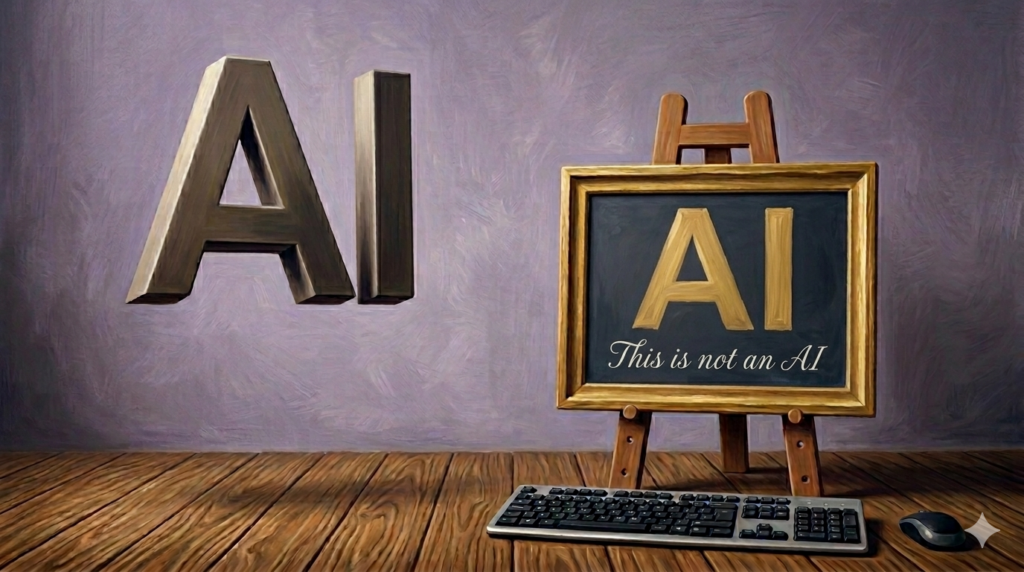
This is not AI (but it is AI ).
Lefteris Giannakoudakis
Writer, director and practice-based researcher exploring Artistic Intelligence and participatory artistic methodologies.
When in 1928-29, according to internet reports (although Foucault in his book of the same name mentions “1926 I think”, planting the seed of doubt from the beginning), René Magritte depicted for the first time a floating pipe of tobacco and wrote below it “this is not a pipe”, he certainly could not have imagined that this phrase would be used in a paraphrase 97 or 98 or even 100 years later (which would be an excellent anniversary occasion for writing this text) to give title and value to the present text which is related to AI (or to AI ). And if this first inscription was repeated in 1966 in a painting depicting a floating pipe and next to it an easel on which is painted another (or the same?) pipe and underneath it again reads “this is not a pipe”, in the work entitled The Two Mysteries to emphasize the transition from the distinction between the representation and the substance of the object, to the questioning of the very concept of representation, as “the second obviously multiplies the intentional uncertainties”, today we can say that these intentional uncertainties have not only multiplied but have been established in all areas of everyday life with the advent of Artificial Intelligence (AI).
There’s nothing easier than recognizing an AI- made design , designed like this (even the Gemini logo is in the bottom right). The trick is to use the same initials A and I to represent two very different ways of approaching the world: AI = Artificial Intelligence , AI = Artistic Intelligence . What is artistic intelligence, how does it differ from artificial intelligence, how much and how does it concern us today, and what can it offer not only to art itself but also to other sectors such as technology and the environment?
Although as we mentioned before, the design was created with the help of AI and specifically with the program with the imaginative and playful title ” nano” banana ”, a title that, as I will try to prove below, only artistic intelligence could give, is undoubtedly the result of human idea and execution, and this is because it arose from a command (a prompt ) that did not aim to increase productivity, nor to produce a product, nor was it prompted by any professional need, nor did it have a clear logic, because what is the point of asking a program to create a bad representation of Magritte ‘s paintings with a good pun, except for the enjoyment of the game, the curiosity of the result, the different view of objects, the questioning of the effort itself and the fear of failure (and therefore of death?), that is, the very characteristics of artistic intelligence?
A mind that “thinks like an artist” (to borrow the title of Will ‘s book) Gompertz ) starts from curiosity, from this “magic if” of Stanislavsky and asks questions that are not prescribed by practical needs. The goal of the artistic mind is not to learn, it is to expand the question by constantly creating new questions. In this action, the creative mind discovers worlds (in order to question them anew).
In the same way, movements in art arise, in the same way, inventions and discoveries arise in science. Where AI sees a given, the one who thinks as an artist focuses on the inner triangle of A, enlarges it and from behind sees stairs that lead to overlapping levels and from Escher ‘s world takes a leap and enters Borges ‘ library , opens a book and dives into a burrow chasing a white hare to emerge from the craters of Mars after a total reset. The world is not a set of data from which it draws information to synthesize its answers (as LLMs do ) but a set of possibilities where what is seen from one angle seems different from another. Thus, the synthesis of different perspectives creates the global picture and not one version of it the one absolute given. Just as in news reporting you must examine all sources to arrive at the historical fact, so in science and in dealing with environmental crises you must see the issue globally, examine all perspectives to arrive at the solution to the problem.
What if the solution is not found? The result that will result from the effort is not the desired one? What if failure lurks everywhere? Then, all the worse for her, the artist always aims to “fail better” as the great Beckett proclaimed, he is ignorant of danger, so he tries again and again, he does not like the first response to the first result, he destroys what he has made in order to compose again, he is a recycler of ideas, efforts and dreams. In all this, he is afraid and cold, the thought of death makes him not to be complacent, makes him seek the impossible, immortality.
Artificial intelligence is not afraid, does not get cold, does not play, is not curious, does not see the world globally. For now, it can manage data with great success (or not) to recompose something from human creations, something that will resemble what man has made, it cannot take the next step, to go “where no man has ever gone before” and as the Star Trek to explore new worlds, new cultures, new technology and new art. It is useful, but only an artistic mind can play with it and create a dwarf banana that will move discreetly taking its brushes and photographs to serve what man constantly asks for and seeks, the unexpected.
(AI has (not) been used to write this text . But no one knows if this statement is entirely true either).